




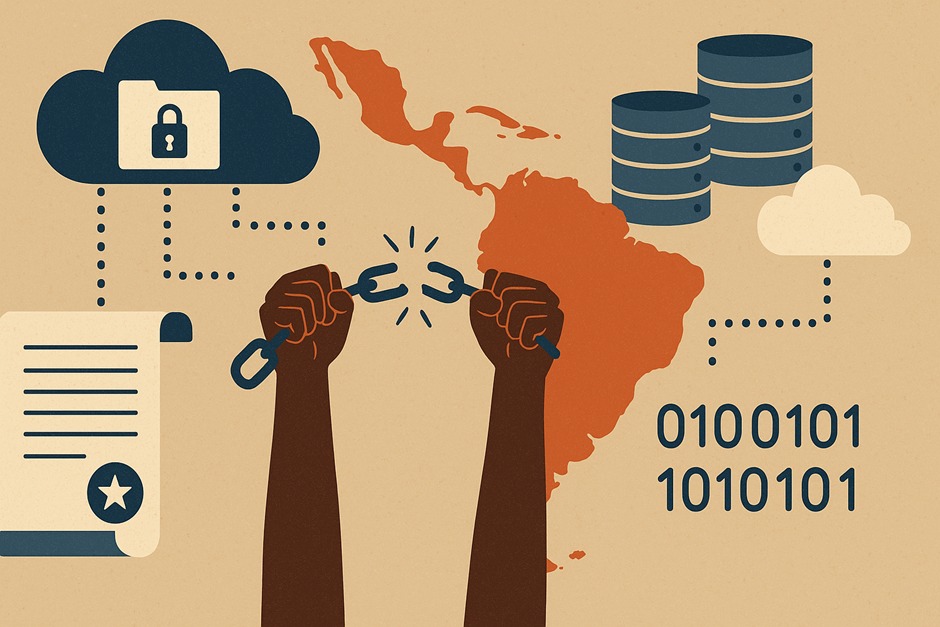
In the digital jungle, data is the new gold—gleaming, hoarded, and fiercely contested. But unlike the ancient conquistadors who plundered Latin America’s physical riches, today’s digital conquistadors don’t arrive on ships—they hover silently above in cloud servers, their flags bearing the logos of Silicon Valley giants. And the question that echoes through the corridors of Latin American parliaments and pressrooms is chilling in its simplicity: Who owns our data now?
Welcome to the Cloud Era, where borders are blurry, cables run under oceans, and your nation’s medical records could be sitting on a server in Iowa. This isn’t some dystopian novel—it’s the daily reality of data sovereignty, and Latin America is waking up from its slumber.
The Great Digital Land Grab
Once upon a time, national sovereignty was defined by borders and flags. Now, it’s defined by servers, encryption keys, and regulatory clauses buried 17 scrolls deep in tech company terms of service. For decades, Latin America has been a digital consumer—downloading apps, uploading identities, and outsourcing storage to American and European providers without blinking. It was convenient. It was cheap. It was, well…colonial, in a new-age way.
The digital conquistadors didn’t ask for permission—they offered “free” services and gobbled up everything from biometric databases to tax records. Cloud computing, for all its promise, became a one-way mirror: Latin Americans saw efficiency and innovation; tech titans saw a treasure trove of exploitable metadata.
And just like that, sovereignty slipped through the cracks.
Awakening in the Andes
But something’s shifting. From Bogotá to Buenos Aires, policymakers and privacy advocates are sounding the alarm. They’ve seen the leaks, the breaches, the scandals. They know that data isn’t just information—it’s infrastructure, power, strategy. It’s the difference between being a digital vassal and a digital sovereign.
Countries like Brazil have taken bold first steps with laws like the Lei Geral de Proteção de Dados (LGPD), its own version of Europe’s GDPR. Others, like Mexico and Argentina, are tightening the reins, demanding data localization and regulatory transparency.
Even indigenous communities are stepping in. The Amazon isn’t just a rainforest—it’s a living network of knowledge, and native groups are fighting for digital land rights, arguing that data extracted from their territories (think DNA samples or linguistic patterns) must remain theirs.
But Can the Region Regain Control?
Let’s not romanticize the resistance too quickly. The cloud isn’t a beast you can cage with a constitution. Most of Latin America’s data still travels through international servers. And the infrastructure to build sovereign clouds—from server farms to secure cables—is expensive, fragile, and politically charged.
Here’s where the metaphor sharpens: Latin America is in the middle of a high-stakes poker game. The chips are your medical records, your purchase history, your location data. The tech giants have been playing this game for decades with marked cards. Latin America? It’s only just learning the rules.
In the thick of this data struggle, one could use a moment of levity. That’s where platforms like Slotsgem come in—offering a digital escape, a space where the only thing at stake is a jackpot, not your digital autonomy. Just don’t forget to read the terms before spinning those reels.
Still, the path to digital independence isn’t paved in firewalls alone. It requires regional alliances. It requires homegrown tech. It requires that citizens care—that they see their data not as a passive shadow, but as an active part of their political and personal identity.
When Clouds Cast Long Shadows
Ask yourself this: If a country can’t store its own census data without routing it through another continent, is it truly free? When your child’s school records are processed on platforms governed by U.S. law, whose rules are they learning under? These aren’t rhetorical musings—they’re the philosophical heartbeat of modern governance.
And yet, there is hope. Chile is building data centers. Uruguay has become a dark horse in cybersecurity. Brazil is standing toe-to-toe with the digital titans. Across the board, young coders, activists, and digital diplomats are weaving a new web—one where Latin America isn’t just plugged into the global internet, but helping shape its architecture.
Amid all the clouds, the silver lining is real: digital sovereignty is no longer a pipe dream. It’s a movement.
A New Digital Liberation
The battle for Latin America’s digital soul will not be fought with swords or soldiers, but with fiber optics and firewall policies. The leaders of this revolution won’t ride in on horseback but will code from coworking spaces in Quito, strategize from cafés in Medellín, and draft privacy legislation in the halls of Brasília.
Skeptics say it’s too late—that the cloud is too vast, too monopolized, too intangible. But remember, once upon a time, they said the same about independence from empires.
So, can Latin America regain control?
If the will is there, and the people care, the answer floats clear through the stormy digital sky: Sí, se puede.

«Experto en Internet. Lector. Fanático de la televisión. Comunicador amistoso. Practicante de alcohol certificado. Aficionado al tocino. Explorador. Malvado adicto a los tweets».
More Stories
Ver | La marchadora española Laura García-Caro se quedó sin subir al podio tras una celebración anticipada
Los compradores británicos impulsan el sector inmobiliario español « Euro Weekly News
El 90% de los usuarios españoles apoyan sus ingresos